


Happy Bastards Combat Explained – Part 2
Take a look at how Combat works inside the Happy Bastards Combat Demo


PART 2 – THE BATTLEFIELD
In preparation for the upcoming release of the COMBAT DEMO, here’s the second of five dev logs that focus on explaining how combat works in Happy Bastards.
Check out Part 1 for the basics, including round structure, movement, actions, hit chance, damage mitigation and undo.
BATTLEFIELD
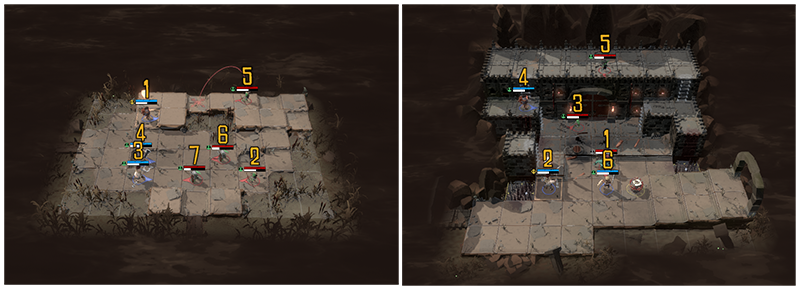
Happy Bastards uses relatively small battlefields. Size and shape vary from one to the other, but in general you can expect something like 6×8 for smaller ones to 15×15 for larger ones.
This size of battlefields has the advantage of making sure it’s action-packed from round 1. It’s a design choice that Happy Bastards’ combat is not about approach strategy or stealth. You start with the enemy right in your face and it’s all about how to attack and defend.
ELEVATION
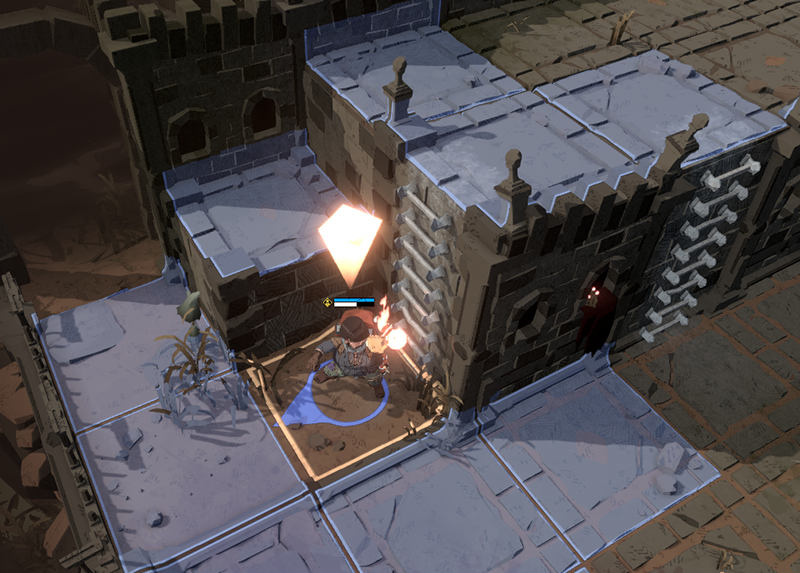
The battlefields in this game are not flat: they use tile height to mimic natural or architectural topography.
Elevation has several important effects on combat gameplay.
The most obvious effect is on movement. Characters can normally climb a height of up to 2 meters, and so a wall higher than that cannot be passed unless there is a ladder. Similarly, a drop of 2m or less is fine, but any higher drop causes fall damage.
Then, there’s line of sight for range abilities. As you can expect, characters, objects and terrain can block line of sight. An attacker can shoot through an ally if the ally is adjacent, but any distance between the two causes a chance for friendly fire. Elevation and character size can sometimes remove the problem, for example if the target is higher than the ally in between or if you’re shooting at a gigantic enemy.
A similar concept is vertical range as each ability checks that parameter when targeting. For example, your sword attack may reach up or down by 2m at most.
Lastly, one type of ability that’s heavily affected by terrain are the move effects, for example the ability to shove a target backwards. The effect of the forced move is then a function of the terrain it passes through. This may cause a collision against a wall, or cause the target to fall down a cliff for fall damage, or cause it to slide all the way to the end of the battlefield if nothing blocks its path.
TILE EFFECTS
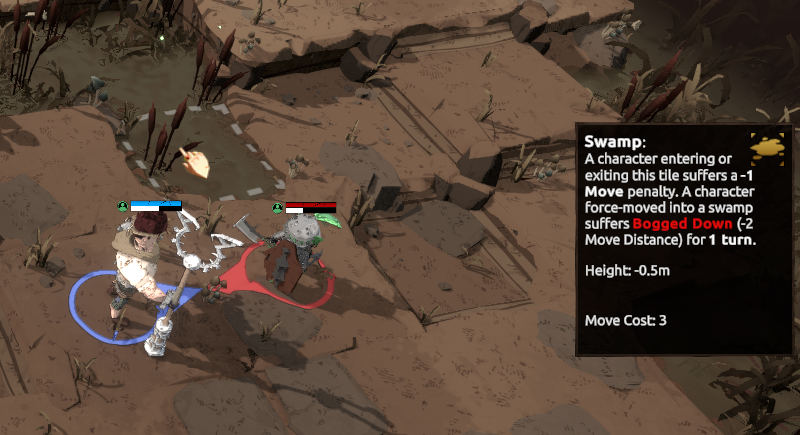
Some tiles on the battlefield come with a specific gameplay effect applied to any character who steps through it or is shoved into it.
For example, a swamp tile costs a move penalty to cross, and imposes a move debuff to any character being shoved into it, while a tall vegetation tile grants a dodge bonus. There are many more and they will influence your tactical decisions.
TRAPS
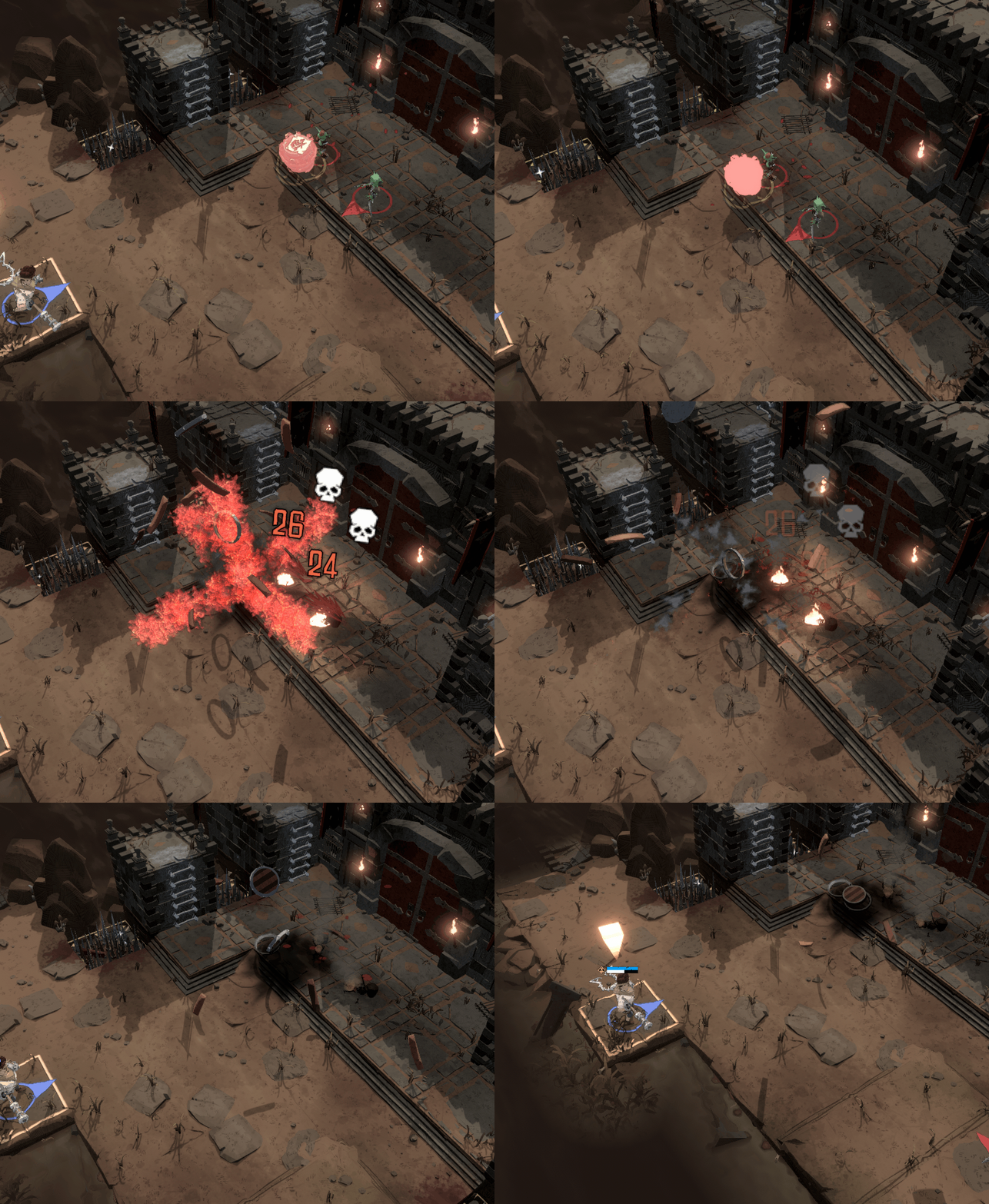
A related concept is that of objects. They sit on a tile on the battlefield and cannot usually be passed through. They can be attacked and possibly destroyed.
While some objects are just obstacles, some are traps and have a gameplay effect. Typically, the effect of a trap is triggered either on destruction, like with the explosive barrel, or through a collision, like with the spike ball or the pit trap. Finding ways to use traps is definitely a fun part of Happy Bastards’ combat.
CHARACTER PLACEMENT
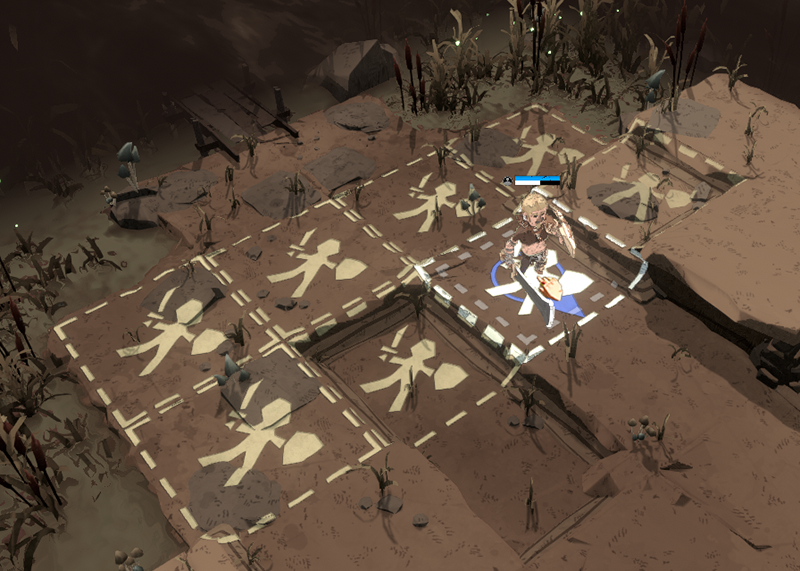
At the start of every combat, the player must decide where to position his/her characters among valid placement tiles.
In the placement phase, and at the end of every character turn, the player has the option to change that character’s facing, in order to protect against back and side attacks.
These decisions can be crucial as opponents are not far away and a bad turn order draw could mean bad news for a poorly placed squishy mercenary.
POSITIONAL BONUSES
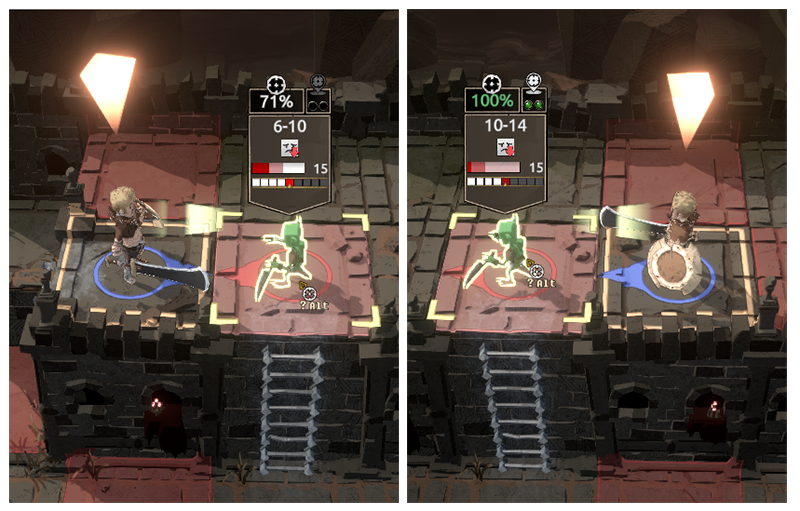
There are 3 targeting modes in this game: melee, range, and ballistic. Each mode has its own positional bonus, which increases damage (or other effects) and hit chance.
Positional bonuses have 2 levels, so either you have no bonus, half bonus or full bonus.
Melee attacks benefit from side or rear attacks, range attacks benefit from elevation relative to the target, and ballistic attacks benefit from being as close as possible (or as far as possible for some) to the target.
Positional bonuses are crucial to success in Happy Bastards. Clever enemies will try to exploit your mistakes and you’ll find that hitting enemies without positional bonuses makes your mercenaries’ lives a lot harder.
CONTROL ZONES
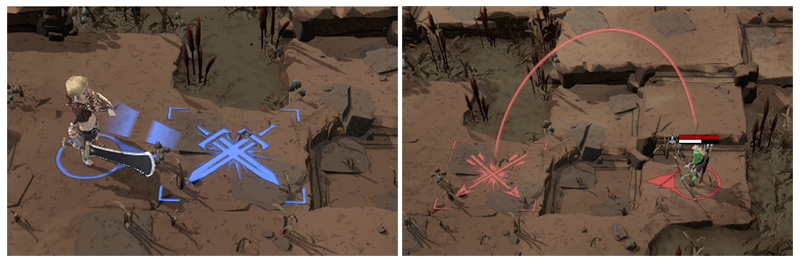
Another aspect of positioning is control zones, which is a passive ability that automatically strikes an enemy who exits the threatened tile.
The range equivalent is called overwatch. It is a passive that threatens a tile 2 distance in front, and strikes any enemy who enters that tile
In Happy Bastards, not everyone has a control zone: it needs to be part of a character’s kit. But those who have them can be instrumental in dictating positioning and therefore the dynamics of combat.
That’s it for today. The upcoming part 3 will focus on the role of your main character in combat through the command system.

See you on the Discord!